Granary Island
The Green Bridge connects the main part of the old town with the Spichrzów or Granary Island. It is not difficult to guess what was located on the island given the name. You can even say that the granaries were here before the island became an island! In the 16th century, when the New Motlawa River was dug, or the east channel was flowing around the island, there were more than 300 granaries. This gives an idea of the origin of the wealth of Gdansk and came from the trade of, among others, grain imported by Polish rafters. In addition to the grain in the granaries, other goods were also stored that reached Gdansk by the same waterway hops, flax, hemp, honey, wood, cloth and much more.
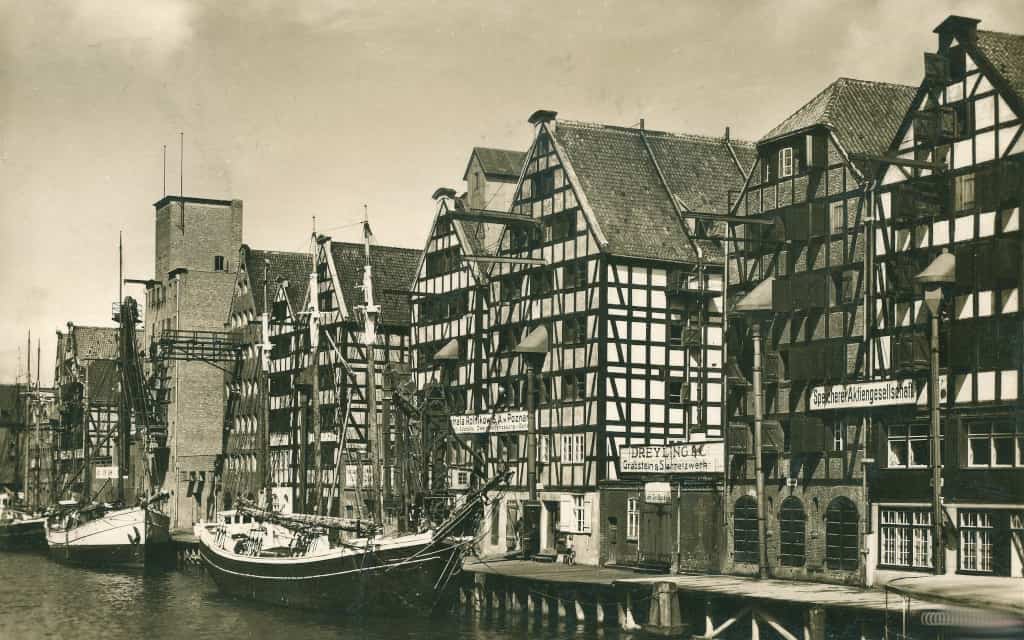
The island was closely guarded, because there were numerous plunderers, which, incidentally, were severely punished, even by death. Access to the island was guarded by bridges lifted at night and … dogs left after dark to defend the property in the granaries. The island experienced both floods (during the largest, in 1540, high water lasted for 2 weeks), and fires one of the most tragic was started in 1516 by members of the Mattern gang, who were marauding in Gdansk.
Wyspa Spichrzów i Motława 1929
Północna część Wyspy Spichrzów 1929
The island was closely guarded, because there were numerous plunderers, which, incidentally, were severely punished, even by death. Access to the island was guarded by bridges lifted at night and … dogs left after dark to defend the property in the granaries. The island experienced both floods (during the largest, in 1540, high water lasted for 2 weeks), and fires one of the most tragic was started in 1516 by members of the Mattern gang, who were marauding in Gdansk. In the 19th century, a railway line was brought to the island, which significantly increased the functionality of granaries and warehouses. At the beginning of the 20th century, Spichrzów Island continued to preserve its former destiny as a large warehouse. World War II brought about a decline. As a result of air raids and bombings almost the entire infrastructure of the island was destroyed. Only three granaries survived: Steffen, Deo and Wisłoujście. So far, 36 others have been rebuilt mainly housing, offices and cultural institutions. Many granaries are still in ruins. Among others: Distant Road, Willow Head, Skeleton’s Skull, White Steed, Red Lion, Prince, Hungary, Turk, Forge, Noah’s Ark, Red Hens (all aforementioned are English translations of Polish names). It is worth mentioning that the majority of Gdansk granaries had their names. Over the centuries such names, now historical, appeared in their hundreds.
-
Flisactwo dawniej i dziś | Polska tradycja na liście UNESCO2023-08-10
-
Zamek Krzyżacki i Królewska Szkoła Nawigacyjna2023-08-02
-
Targ Rybny2023-08-02
-
Spichlerz Królewski Filharmonia Bałtycka2023-08-02
-
Narodowe Muzeum Morskie i statek Sołdek2023-08-02
-
Ołowianka2023-08-02
-
Brama Świętojańska i Brama Straganiarska2023-08-02
-
Ośrodek Kultury Morskiej2023-08-02
-
Żuraw Gdański2023-08-02
-
Dom Przyrodników2023-08-02
